External cephalic version: what if your baby is breech?
What does an external cephalic version mean and what can you expect?
You’re in the final trimester of your pregnancy and are probably already thinking about the birth. But then you hear that your baby is in a breech position. And suddenly you’re faced with the question: do you go for an external cephalic version or not? That can take some getting used to, and you’ll naturally want to know more about such a version. We’ll explain it to you – in our midwifery practice in Amsterdam if you come and see us, or here, online, in this blog. And if you still have questions afterwards? Let us know, we’re here for you.
What is an external cephalic version?
An external cephalic version is an attempt to turn your baby from the outside into a head-down position. This is performed by a specialised midwife or gynaecologist and usually takes place around 35 or 36 weeks of pregnancy. If you’ve given birth before, it can sometimes be done a little later in the pregnancy. The aim of an external cephalic version is to move your baby from a breech position into a head-down position, since that is the most favourable position for a vaginal birth.
What is a breech presentation?
Towards the end of pregnancy, most babies lie head-down. But in around 4% of cases, that isn’t so. The baby then lies bottom-down, known as a breech presentation. Sometimes a baby lies transversely. Why this happens is usually unclear. But know that it isn’t an abnormality – it’s simply a different position.
How does a version take place?
During an external cephalic version, a specialised midwife or gynaecologist gently guides your baby using their hands on your belly. This usually happens as follows:
- You lie on a bed and the specialist feels how your baby is positioned.
- They then gently apply pressure to the baby’s bottom and head, very carefully.
- Next, they try to guide your baby towards the side of your belly.
- From that point on, your baby can turn by itself.
Nothing is forced during this entire treatment. If your baby still doesn’t turn despite everything, the version is stopped. It can then be tried again another time. During a second attempt, medication is sometimes given to relax your womb. And sometimes a second pair of hands is brought in to increase the chance of success.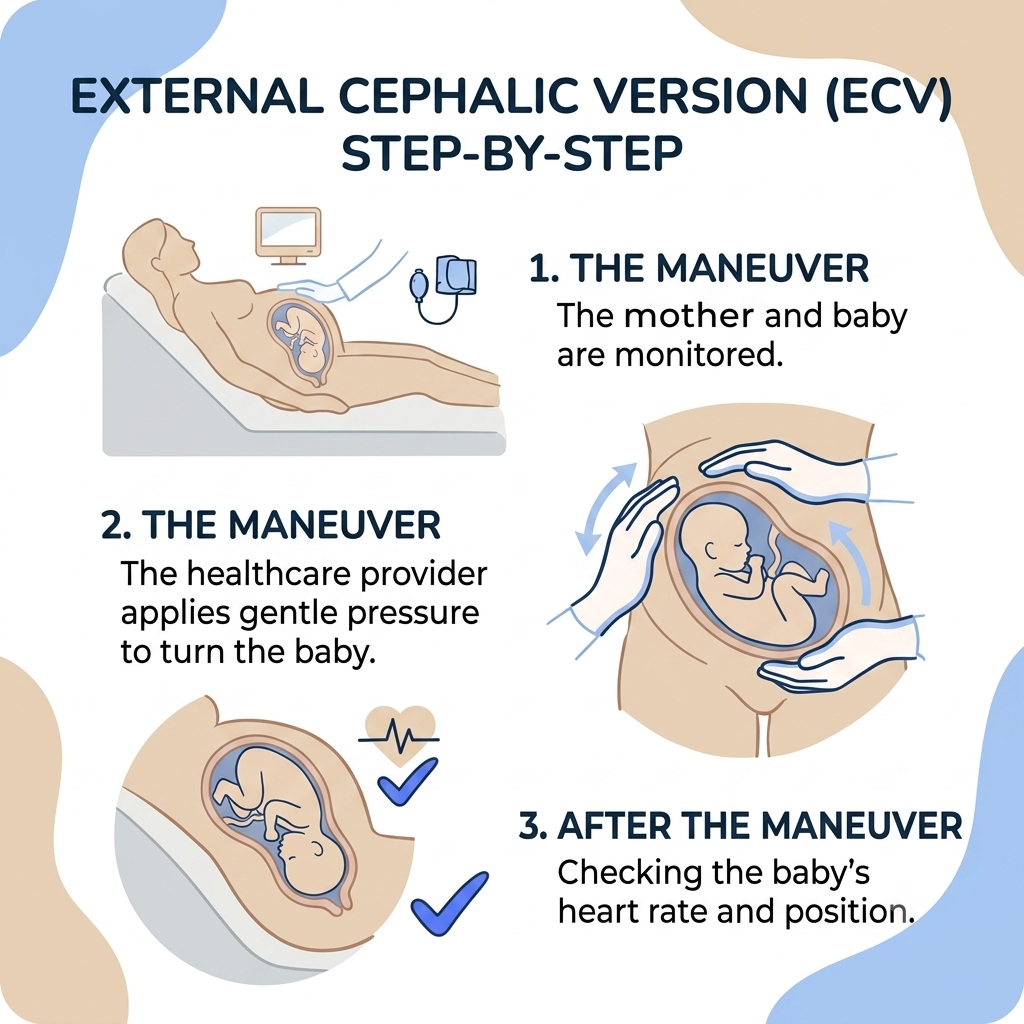
An external cephalic version = a safe procedure
A version is a safe procedure. That doesn’t mean it’s always successful. Half of all attempts succeed on the first try. Sometimes a second attempt is needed, and sometimes it doesn’t work at all. The chance of a successful version is greater if you’ve given birth before. There also needs to be enough room in your belly for the baby to be able to turn. But know that your baby feels no pain from the version and that nothing is damaged. You and your baby are, in any case, closely monitored, both during and after the version. And the chance that your baby turns back afterwards? That rarely happens. Once turned, most babies stay neatly in the desired position.
Version, not necessarily in hospital
Contrary to what many women think, an external cephalic version doesn’t have to be carried out in hospital at all. The specialist performing the version only needs monitoring with a doptone (handheld Doppler), so the version can also be done at other locations. If medication is needed to relax the womb, you will need to go to hospital for the version.
What if an external cephalic version doesn’t work?
If it isn’t possible to turn the baby, it will remain in a breech position. In that case, you’ll be referred to the hospital. There, you’ll discuss your options with the gynaecologist. These can include a vaginal breech birth or a caesarean section. Whether you get to choose depends on your situation. If you can choose between both options, they are both medically sound for you.
Does an external cephalic version have any drawbacks?
An external cephalic version is safe and the drawbacks are limited, but it’s good to know what to expect. The treatment itself can feel uncomfortable, and you may feel bruised afterwards. This fades by itself and is harmless. Also, a version never comes with a guarantee of success: as mentioned, it works in around 50% of attempts. A second attempt may therefore be needed, if you wish.
Frequently asked questions about external cephalic version
What is an external cephalic version?
An external cephalic version is an attempt to turn your baby from the outside into a head-down position.
What is a breech presentation?
A breech presentation means your baby is lying bottom or feet first instead of head first.
How does a version take place?
During a version, a specialist guides your baby with their hands on your belly so that it can turn.
Does an external cephalic version hurt?
Most women find it intense or uncomfortable, but not really painful.
What are the drawbacks of a version?
It can be uncomfortable, it doesn’t always work, and you may feel temporarily bruised.
Questions about an external cephalic version? Visit Verloskundigen Amsterdam Zuid
A breech presentation can be unexpected news that leaves you with doubts and wanting to talk things through properly before deciding whether or not to have an external cephalic version. We understand that, and we’re here to answer your questions and talk with you about this situation in your pregnancy. Would you like to know more about an external cephalic version? Take a look at the Stuit in West website, where you’ll find plenty of information (also in English) as well as a video about the external cephalic version. Of course, you’re always welcome to contact us with any questions you may have. The midwives at our practices in Amsterdam-Zuid are ready for you.